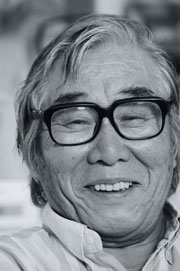
Mitsuyoshi Haruguchi, like Chimei Hamada and Yukio Hideshima, is an artist who chooses to live in Kumamoto as opposed to Tokyo, a choice that has many of the art critics wondering. In an interview for the museum news published by the Contemporary Art Museum, Kumamoto Chimei Hamada put it quite simply “Where I live has nothing to do with my art activities. If anything meeting people less bothers me more in Kumamoto than Tokyo”. Although Haruguchi applied to “The Exhibition of SHINSEISAKU” several times after graduating from university, and had the opportunity to be recommended for the “Exhibition of Yasui Award”, he held in his conscience a sense that even the Exhibition of SHINSEISAKU did not offer much potential, as long as it was one of those art saloons. Thus he has adhered to the pursuit of solitary activities to this day, never attending any kind of art saloons.
His intrinsic discerning ability can be seen in his way of approaching the universal truth. He always goes against the tides of conventional method. For example, while he was studying at Kyoto City University of Arts, although he had passed the fiercely contested exam to become a student of the Class of Western Painting, he pushed himself even further by choosing to study in the Class of Art Theory, which focuses on the theoretical aspects of art. Furthermore, he stayed in Europe several times and studied at the Kunst Akademy, Vienna. Thus he has always endeavored to put himself in the world of the great history of art and consistently chosen the solitary and austere way of working.
For him, where to produce artwork was not a great concern. He might have been provoked by a precocious and transcendental inspiration, that fine-art is not existing to be seen by some precarious spectators in the characteristically superficial atmosphere of art saloon venues, but existing genuinely to relate an artist with God to show a proof of miraculous matter, which reveals itself only by the help of not Eros but Thanatos, a generative Death in other words. Creating fine art should be essentially focused on ascertaining the actuality of the cognitive truth, and Haruguchi is an artist who has never deceived his original commitment to dedicate his life to accomplish the vocation endowed unto the artist, and has persevered to materialize the purity of Death. In the early stage of his life as an artist, he instinctively knew that only through drawing Death, could an artist fulfill his calling. Conversely, this proves that he was appointed by some power to be an artist.
Mitsuyoshi Haruguchi was born in 1933, in Tsuboi, Kumamoto City. His father, an art lover who aspired to become a novelist, cared greatly for the young Mitsuyoshi and gave him his first painting kit when he was just a child. However, time was heading towards a devastating destiny. Although he was a mere child, it may well have been then that he instinctively felt that the two factors, the beginning of worldwide chaos (Death) and the painting of a picture, would somehow harmoniously miraculously overlap each other. It is no exaggeration to say that it was a monumental period in his artistic career. With such feelings lying hidden and undeveloped within, Haruguchi entered Seiseiko-Highschool in 1946 and started to paint pictures as devotedly as ever. Starting with several prizes from student exhibitions, he won a lot of prizes such as; Kumanichi Art Exhibition prize sponsored by Kumamoto-nichi-nichi Newspaper, and the “Mayor’s Prize” at Kumamoto Art Association Exhibition (unusual for a high school student). Thus he became renown nationwide for his fantastic artistic technique. He was only a third grader at high school when he was granted the chance to become a student of Kinosuke Ebihara at “The First Ebihara Art Laboratory”. Kumamoto had already gained the capacity and matured enough to accept early-developed and talented artists. However, Haruguchi did not try to emulate his fellow students, who were much older than him, but was instead inclined to keep his distance from them. His inherent sensibility told him how to act and to what extent. Indeed, he must have behaved similarly to Kinosuke Ebihara. Actually, although he was physically staying in Kumamoto, his inner self, a 17-year-old boy, had already been flying away from Kumamoto, emancipated from nostalgic adherence to the homeland and its habits, and was already in the kingdom of his aesthetic world.
When he was of an age to enter university, he didn’t choose Tokyo, which many regarded as a symbol of power, but instead decided to go to Kyoto, a symbol of Freedom and Philosophy, where he entered Kyoto City University of Arts. Rather than lessons in painting technique, he was very much attracted by the lectures given by Shigenobu Kimura, who was still young then but later became one of leading figures in Art Anthropology. Even now you will be amazed by the profound depth and diversity of Shigenobu Kimura’s knowledge and methodology, which he has applied in trying to approach the heart of art. His theory of aesthetics was revolutionary enough to subvert the conventional narrow-sighted history of art, and was no other than discourse regarding human beings, who were created from the womb of Death. His influence must have provided fresh texture to Haruguchi’s art works. While he was staying in Kyoto, he joined “Democrat Art Association” in Osaka. This association was one of the most radical avant-garde groups of the time and focused on theoretical approach, an attitude which was entirely different from that of the ordinary art saloon organizers. In his artworks that remain today, you can see that the group had a certain influence on him. It was around that time he met Chimei Hamada in Kumamoto.
After graduating from university, Haruguchi returned to Kumamoto to take care of his elderly parents and became a high school teacher. What you can see in the monochrome images of works such as “Persona Series” is his inner emotion of those days. It seems they protest without words against the reality of Kumamoto. Whatever sentiment he had, the ability bound up inside of him burst out when he won the third prize of the Shell Art Prize in 1962, and earned nationwide reputation. It triggered a movement of his life to the next stage. By then, his compelling desire to study in Europe intensified to an extent that he could no longer resist.
In order to make his dream come true, his supporters established an association. Tomito Izu, Kyoei Yoshimi, and Yasushi Shimojyo, the representatives of the assigned regions, established an office in a gallery and tearoom, known as “Serpent”, and raised money by selling works at exhibitions held at various locations. Their efforts eventually allowed Haruguchi to go on a 6-month study tour over 17 nations of the world, starting with the “International Conference of Art Education” in Montreal, Canada. For young Haruguchi, it was a voyage which made him convinced that his artistic perspective was correct. He was determined to return to Europe, but this time as a painter, not a traveler.
The Kunst Akademy, Vienna had long been regarded as one of the most prestigious art institutes in Europe. It attracted the world’s attention further when the Viennese School of Fantastic Realism, the Fantastic Realism in other words, made its stunning debut at the beginning of 1960’s. From the historic perspective, it was still the Post-War era, and the world’s art scene was dominated by American abstract expressionism, from which Neo Dadaism and Pop Art were emerging. In Eastern Europe, on the other hand, Vienna was the center of culture, and it was from there that a renaissance of painting occurred from the movement of realism in the name of the Viennese School of Fantastic Realism. This should not necessarily be considered to be a collision of antagonistic movements, indeed it is more important to appreciate that both movements in fact stemmed from the same root, that is, they were both born of a time and human emotion sharply defined by reflection on the destruction that happened during the Second World War.
It is possibly for this reason that Haruguchi may have sensed the contemporary nature of Fantastic Realism. Speaking of its artistry, Fantastic Realism respected literary texture and created Figurative Art with precise depiction. If one considers its precursor, Surrealism, which emerged from people dwelling on the human destruction which occurred during the First World War, and also therefore had Death as the seed for its own growth, one begins to appreciate that Fantastic Realism was born in the shape of classicism as an answer to the same question of how we should overcome perpetually recurring homicide with an artistic approach. In his masterpiece “The Ark of Odysseus”, which is displayed in the Vienna Museum of History, Rudolf Hausner, a former teacher of Haruguchi, shows the metamorphoses of his own face, but at the same time it reveals itself as the face of Death that awaits us in the locus of Death for human beings. It also reminds us of the stage of Death, as connoted in Anton Lehmden’s Leonardo Da Vinci, which is the very sphere God’s stand, the end of the world. It can be said that the entity of God once denied by Surrealism was resurrected in Viennese Fantastic Realism, as a metaphorical figure behind the apocalyptic image.
Haruguchi gained requisite skill in Europe. But additionally, and unconsciously, he was endowed, during his laborious training days in Vienna, with proximity to the existence of God, the Deity within the works of art, who appears in the same figure when evoked from Death. From the very beginning of his career, he pursued what he was finally awarded with. This revelation was embodied later in Japan in “Trojan Horse”, “Rebirth Cycle” series, “Supper”, “Man and Woman ? Love”, and “SOS”.
Destruction and rebirth of the artist never come to an end. Following the history of Haruguchi for half a century, I came to realize that each stroke of his brush touches the universal truth he felt transcendentally, as if submerging into the depths. Both his eyes, and the movements of the brush as his eyes’ metaphor, have the same tactile sensation to God. Haruguchi’s paintings are invariably moist. This moistness is that of Death, the Drop of Thanatos. True art will never die, because Death is Death itself. Death will never die. That’s why God presents himself there. A person, who accepts this universal truth and keeps pouring down the drops in the brush head conscientiously onto the canvas, must be a person who God would call a painter. Haruguchi’s fine art is reminding us of this truth, as the Apocalypse of our time.
Mitsuyoshi Haruguchi was born in 1933, in Tsuboi, Kumamoto City. His father, an art lover who aspired to become a novelist, cared greatly for the young Mitsuyoshi and gave him his first painting kit when he was just a child. However, time was heading towards a devastating destiny. Although he was a mere child, it may well have been then that he instinctively felt that the two factors, the beginning of worldwide chaos (Death) and the painting of a picture, would somehow harmoniously miraculously overlap each other. It is no exaggeration to say that it was a monumental period in his artistic career.
With such feelings lying hidden and undeveloped within, Haruguchi entered Seiseiko-Highschool in 1946 and started to paint pictures as devotedly as ever. Starting with several prizes from student exhibitions, he won a lot of prizes such as; Kumanichi Art Exhibition prize sponsored by Kumamoto-nichi-nichi Newspaper, and the “Mayor’s Prize” at Kumamoto Art Association Exhibition (unusual for a high school student). Thus he became renown nationwide for his fantastic artistic technique. He was only a third grader at high school when he was granted the chance to become a student of Kinosuke Ebihara at “The First Ebihara Art Laboratory”. Kumamoto had already gained the capacity and matured enough to accept early-developed and talented artists. However, Haruguchi did not try to emulate his fellow students, who were much older than him, but was instead inclined to keep his distance from them. His inherent sensibility told him how to act and to what extent. Indeed, he must have behaved similarly to Kinosuke Ebihara. Actually, although he was physically staying in Kumamoto, his inner self, a 17-year-old boy, had already been flying away from Kumamoto, emancipated from nostalgic adherence to the homeland and its habits, and was already in the kingdom of his aesthetic world.
When he was of an age to enter university, he didn’t choose Tokyo, which many regarded as a symbol of power, but instead decided to go to Kyoto, a symbol of Freedom and Philosophy, where he entered Kyoto City University of Arts. Rather than lessons in painting technique, he was very much attracted by the lectures given by Shigenobu Kimura, who was still young then but later became one of leading figures in Art Anthropology. Even now you will be amazed by the profound depth and diversity of Shigenobu Kimura’s knowledge and methodology, which he has applied in trying to approach the heart of art. His theory of aesthetics was revolutionary enough to subvert the conventional narrow-sighted history of art, and was no other than discourse regarding
human beings, who were created from the womb of Death. His influence must have provided fresh texture to Haruguchi’s art works. While he was staying in Kyoto, he joined “Democrat Art Association” in Osaka. This association was one of the most radical avant-garde groups of the time and focused on theoretical approach, an attitude which was entirely different from that of the ordinary art saloon organizers. In his artworks that remain today, you can see that the group had a certain influence on him. It was around that time he met Chimei Hamada in Kumamoto.
After graduating from university, Haruguchi returned to Kumamoto to take care of his elderly parents and became a high school teacher. What you can see in the monochrome images of works such as “Persona Series” is his inner emotion of those days. It seems they protest without words against the reality of Kumamoto. Whatever sentiment he had, the ability bound up inside of him burst out when he won the third prize of the Shell Art Prize in 1962, and earned nationwide reputation. It triggered a movement of his life to the next stage. By then, his compelling desire to study in Europe intensified to an extent that he could no longer resist.
In order to make his dream come true, his supporters established an association. Tomito Izu, Kyoei Yoshimi, and Yasushi Shimojyo, the representatives of the assigned regions, established an office in a gallery and tearoom, known as “Serpent”, and raised money by selling works at exhibitions held at various locations. Their efforts eventually allowed Haruguchi to go on a 6-month study tour over 17 nations of the world, starting with the “International Conference of Art Education” in Montreal, Canada. For young Haruguchi, it was a voyage which made him convinced that his artistic perspective was correct. He was determined to return to Europe, but this time as a painter, not a traveler.
The Kunst Akademy, Vienna had long been regarded as one of the most prestigious art institutes in Europe. It attracted the world’s attention further when the Viennese School of Fantastic Realism, the Fantastic Realism in other words, made its stunning debut at the beginning of 1960’s. From the historic perspective, it was still the Post-War era, and the world’s art scene was dominated by American abstract expressionism, from which Neo Dadaism and Pop Art were emerging. In Eastern Europe, on the other hand, Vienna was the center of culture, and it was from there that a renaissance of painting occurred from the movement of realism in the name of the Viennese School of Fantastic Realism. This should not necessarily be considered to be a collision of antagonistic movements, indeed it is more important to appreciate that both movements in fact stemmed from the same root, that is, they were both born of a time and human emotion sharply defined by reflection on the destruction that happened during the Second World War.
It is possibly for this reason that Haruguchi may have sensed the contemporary nature of Fantastic Realism. Speaking of its artistry, Fantastic Realism respected literary texture and created Figurative Art with precise depiction. If one considers its precursor, Surrealism, which emerged from people dwelling on the human destruction which occurred during the First World War, and also therefore had Death as the seed for its own growth, one begins to appreciate that Fantastic Realism was born in the shape of classicism as an answer to the same question of how we should overcome perpetually recurring homicide with an artistic approach. In his masterpiece “The Ark of Odysseus”, which is displayed in the Vienna Museum of History, Rudolf Hausner, a former teacher of Haruguchi, shows the metamorphoses of his own face, but at the same time it reveals itself as the face of Death that awaits us in the locus of Death for human beings. It also reminds us of the stage of Death, as connoted in Anton Lehmden’s Leonardo Da Vinci, which is the very sphere God’s stand, the end of the world. It can be said that the entity of God once denied by Surrealism was resurrected in Viennese Fantastic Realism, as a metaphorical figure behind the apocalyptic image.
Haruguchi gained requisite skill in Europe. But additionally, and unconsciously, he was endowed, during his laborious training days in Vienna, with proximity to the existence of God, the Deity within the works of art, who appears in the same figure when evoked from Death. From the very beginning of his career, he pursued what he was finally awarded with. This revelation was embodied later in Japan in “Trojan Horse”, “Rebirth Cycle” series, “Supper”, “Man and Woman ? Love”, and “SOS”.
Destruction and rebirth of the artist never come to an end. Following the history of Haruguchi for half a century, I came to realize that each stroke of his brush touches the universal truth he felt transcendentally, as if submerging into the depths. Both his eyes, and the movements of the brush as his eyes’ metaphor, have the same tactile sensation to God. Haruguchi’s paintings are invariably moist. This moistness is that of Death, the Drop of Thanatos. True art will never die, because Death is Death itself. Death will never die. That’s why God presents himself there. A person, who accepts this universal truth and keeps pouring down the drops in the brush head conscientiously onto the canvas, must be a person who God would call a painter. Haruguchi’s fine art is reminding us of this truth, as the Apocalypse of our time.
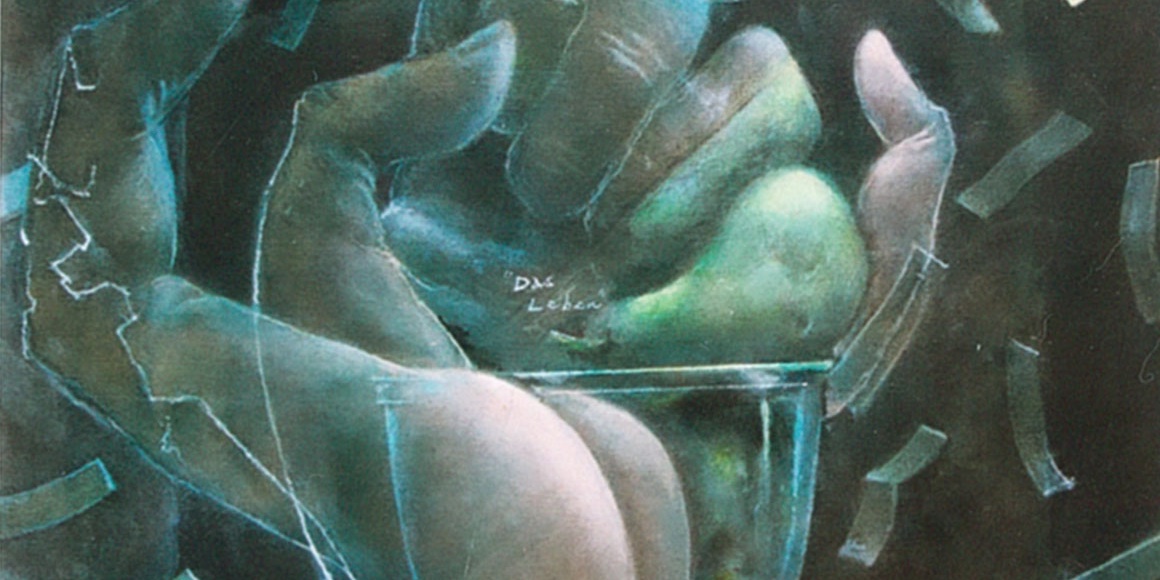 WORKS
WORKS